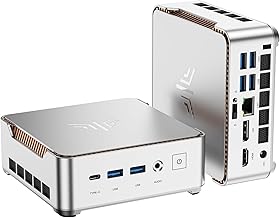
The pocketable mini PC has rarely been a serious platform for discrete graphics, but the GPD BOX tries to change that. Its Core Ultra 7 356H configuration carries an MCIO 8i connector wired to a PCIe 5.0 x8 link rated at up to 512Gbps of bidirectional bandwidth, enough to drive an external GPU dock, enterprise NVMe arrays, multi-bay storage, or capture cards without the usual Thunderbolt bottleneck. The whole system is built on Intel's new Core Ultra Series 3 "Panther Lake" silicon, fabricated on the company's 18A process with 16 CPU cores.
GPD splits the lineup into two chips that trade graphics for expansion. The Core Ultra X7 358H clocks to 4.8GHz and pairs Intel Arc B390 graphics (1536 shader units) with a claimed 180 TOPS of total INT8 AI throughput, but it forgoes the MCIO port and reaches external GPUs only over USB4. The Core Ultra 7 356H tops out at 4.7GHz with a smaller 512-shader iGPU and up to 100 TOPS, and it is the only model with the direct PCIe 5.0 x8 path for high-bandwidth add-in hardware.
That expansion story lands well on Linux. Intel's Xe3 iGPU support was declared stable and enabled by default in Mesa 25.1.6, requiring Linux 6.17 or later for out-of-the-box support via the in-kernel xe driver without needing the INTEL_FORCE_PROBE override that previously gated the driver as experimental. Ubuntu 25.10 and Fedora 43 are both targeting that kernel and Mesa pairing. The fifth-generation NPU is equally well covered: the IVPU kernel driver for Panther Lake landed in Linux 6.13, Intel subsequently published NPU firmware to linux-firmware.git, and the open-source user-space driver covers the 50xx NPU series, completing the platform's Linux driver stack. USB4 and PCIe eGPU setups are increasingly workable on current distributions. GPD states the fingerprint reader in the power button is Linux-compatible, and Linux 7.1 adds a dedicated Panther Lake C-states table alongside FRED enabled by default, the latter reducing CPU event-delivery overhead for measurable performance gains on this silicon.
The rest of the spec sheet is dense: up to 64GB of LPDDR5x-8533 memory, two M.2 slots (a primary PCIe Gen5 x4 plus a secondary Gen4 x2) with advertised sequential reads up to 15,000MB/s, two USB4 v2.0 Type-C ports at 80Gbps, four USB 3.2 Gen2 Type-A ports, DisplayPort 2.1 UHBR20, HDMI 2.1 FRL, dual 2.5GbE, WiFi 6E, and Bluetooth 5.3. The machine can drive four displays at once, includes a discrete dTPM 2.0 chip and a fingerprint reader in the power button, and runs a 15W to 80W TDP range adjustable in BIOS. The enclosure measures 175 x 134 x 39.5 mm (6.9 x 5.3 x 1.6 inches) and weighs about 940 grams (2.1 lbs), with a dual-fan cooler and an integrated 160W GaN supply that eliminates the external brick.
GPD is selling a companion G2 eGPU dock built around an 800W Gold-rated server-grade power supply, intended for the MCIO-equipped 356H. It accepts full-size PCIe cards, and GPD claims only around a 2% performance loss with an RTX 4090, a vendor figure that awaits independent confirmation. On Indiegogo, the 356H with 32GB of soldered memory and 1TB of storage starts at roughly $1,450 (€1,335), with the 358H at the same configuration around $1,534 (€1,425). Dock bundles begin near $1,850 (€1,700) for the 356H and $1,900 (€1,750) for the 358H. Estimated delivery is listed for August 2026.