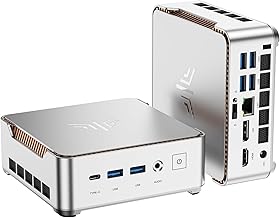
For anyone building a compact Linux box or home server, Gigabyte's latest BRIX mini PCs lean hard into expansion. Each of the three new barebones systems holds two M.2 2280 SSDs, with one slot running at PCIe 5.0 x4 and the other at PCIe 4.0 x4, plus a populated M.2 2230 E-key slot carrying an RTL8922AE card for WiFi 7 and Bluetooth 5.4. Networking runs over 2.5 GbE through an Intel I226LM controller, covered on Linux by the in-kernel igc driver, and the whole thing fits in a 119 x 113 x 34mm (4.7 x 4.4 x 1.4 inches) chassis.
The three models are built around Intel's Core Ultra (Series 3) Panther Lake mobile chips. The entry GB-BRU5-322 uses a 6-core Core Ultra 5 322, the GB-BRU7-355 steps up to an octa-core Core Ultra 7 355, and both take up to 96GB of DDR5-5600 across two SODIMM slots (or DDR5-6400 with CSODIMM modules). The top GB-BRU9-386H runs a 16-core Core Ultra 9 386H and supports up to 128GB of DDR5-6400. All three share a 25W processor base power, but the Core Ultra 9 turbos to 80W versus 55W on the lower tiers, which is why it ships with a 140W USB-C adapter rather than the 100W brick on the others.
These chips land on Linux in good shape. Their Xe3 integrated graphics gained stable kernel support in Linux 6.17, with Mesa 25.2 enabling OpenGL and Vulkan for Panther Lake by default, and Intel has upstreamed the GuC, DMC, and GSC firmware blobs needed for the GPU to come up cleanly. The platform's NPU has been handled by the kernel since 6.13, and Linux 7.1 added FRED and Panther Lake C-state tuning for the idle driver, so a recent rolling-release distro covers the hardware without out-of-tree patches. For coreboot fans, Coreboot 26.03 added Panther Lake support as well. Gigabyte officially lists Ubuntu 25.10 alongside Windows 11 as a supported OS. The RTL8922AE WiFi 7 card uses the rtw89 driver that has been in mainline since kernel 6.10, though some users have reported intermittent disconnects under heavy wireless load. On the NPU side, Intel's Linux NPU Driver added Panther Lake support and pairs with the OpenVINO 2026 toolkit to route inference workloads across the CPU, GPU, and NPU from a single software layer.
I/O is generous for the size. The ports include two USB-C with DisplayPort 2.1 Alt Mode, a third USB 3.2 Gen 2 Type-C, three USB 3.2 Gen 2 Type-A, one USB 2.0 Type-A, two HDMI 2.1 outputs, the 2.5 GbE jack, and a 3.5mm audio combo. Gigabyte has not announced pricing or a firm release date for the BRIX lineup yet.