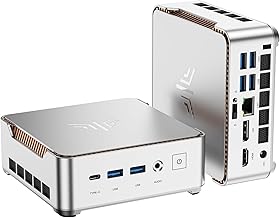
External GPU docks have long suffered from a bandwidth bottleneck that leaves desktop graphics cards performing well below their potential. GPD thinks it has a fix. The company is bringing MCIO 8i, a connector standard borrowed from the server world, to two upcoming consumer products: the GPD BOX mini PC and the GPD G2 graphics dock. With PCIe 5.0 x8 support delivering up to 256 Gbps of bandwidth, the pairing promises roughly four times the throughput of OCuLink setups. GPD claims an RTX 4090 installed in the G2 dock loses only about 2% of its performance over MCIO 8i compared to a direct PCIe x8 slot in a desktop.
The GPD BOX will ship in two configurations, both powered by Intel Panther Lake processors. The model with MCIO 8i uses an Intel Core Ultra 7 356H with 4-core integrated graphics, while a second variant swaps the MCIO port for Intel's more powerful Core Ultra X7 358H with 12-core Arc B390 integrated graphics. Both models support up to 64GB of LPDDR5x-8533 memory, dual M.2 storage (one PCIe 5.0 x4, one PCIe 4.0 x2), two 2.5 GbE LAN ports, and two USB4 v2 ports rated at 80 Gbps each.
For open-source users weighing those two configurations, Intel's underlying platform already has meaningful driver coverage in place. The Arc B390 Xe3 iGPU in the 358H variant runs on Intel's open-source graphics stack, and Phoronix benchmarks show it outperforming AMD's Radeon 890M by around 23% in Linux gaming tests, with the open-source Intel Compute Runtime also delivering strong results on GPU compute workloads. The Panther Lake platform additionally carries upstream Linux kernel patches for its NPU 5 AI accelerator, relevant to those running open-source inference tools locally. These represent chipset-level milestones rather than verified device support for the GPD BOX itself, which has not yet shipped.
The G2 dock itself is a compact unit measuring 15.7 x 12.0 x 18.2 cm (6.2 x 4.7 x 7.2 inches) with an aluminum-magnesium alloy chassis. Inside, there is a physical PCIe x16 slot running at 8 electrical lanes for the GPU, an M.2 2280 slot for an optional PCIe 3.0 x2 SSD, an integrated 800W power supply, and connectivity including Gigabit Ethernet and USB 3.2 Gen 2 ports. It also supports USB4 v2 as a fallback connection, though that path is limited to PCIe 4.0 x4 speeds.
GPD is not the first to push PCIe 5.0 x8 bandwidth to an external GPU. Khadas and Beelink have both shipped similar solutions, but each relies on proprietary connectors that lock users into a single vendor's ecosystem. MCIO 8i is an existing industry standard already deployed in servers, which means GPD's dock could theoretically work with any future device that adopts the same connector. Whether other manufacturers follow GPD's lead remains to be seen, but the company's track record of popularizing OCuLink in handhelds suggests it could happen. Pricing and availability for both the GPD BOX and GPD G2 have not been announced.