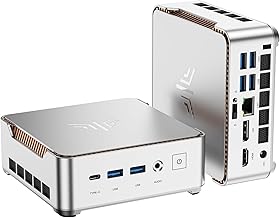
Sapphire has unveiled its latest Edge AI mini PC powered by AMD's Ryzen AI Max+ 395 APU, bringing desktop-class gaming performance to an ultra-compact form factor. The Strix Halo processor packs 16 full Zen 5 cores running up to 5.1 GHz alongside a Radeon 8060S iGPU with 40 compute units based on RDNA 3.5 architecture, delivering performance comparable to an Nvidia GeForce RTX 4070 Laptop GPU. With support for up to 128 GB of LPDDR5X-8000 RAM that can be shared with the integrated graphics, the system enables local deployment of large language models that would require dedicated GPUs with substantial VRAM in traditional setups.
Sapphire demonstrated an intriguing daisy-chaining capability where multiple Edge AI Max+ 395 units can be connected via USB-C to pool their resources together. This setup allows users to run even larger AI models locally by combining the processing power and memory capacity of multiple systems. The USB-C connection likely uses the 80 Gbps USB 4 v2 standard found in other Strix Halo systems, though Sapphire has not confirmed the exact specification. Since the mini PC features only a single Ethernet port, the USB-C approach provides a more practical solution for linking multiple units than network-based clustering.
Linux support for Strix Halo systems has improved significantly heading into 2026, with modern distributions like Fedora 42 and Ubuntu 25.04 working well on the platform using Linux kernel 6.14 or newer and Mesa 25.0. The Radeon 8060S graphics operate properly through the open-source AMDGPU driver stack, though ROCm compute support for the integrated GPU remains in development. Community projects like AMD Strix Halo Toolboxes provide containerized environments for running LLMs on Strix Halo systems across multiple distributions, while ROCm 7.2 updates continue to bring improvements to the compute stack for users running local AI workloads on Linux.
The company plans to officially unveil the Edge AI Max+ 395 at Computex 2026, with pricing and availability details to be announced at that time. Given that competing Strix Halo mini PCs like the GMKtec Evo-X2 retail for around $2,700 (€2,485), the Sapphire system will likely land in a similar price range when it launches later this year.