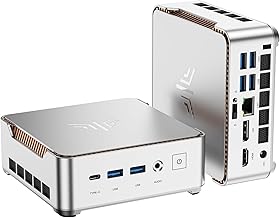
Intel's new low-end Core 3 N304 puts a single Performance core back into the budget mini PC class, and the MINIX N304-AI is one of the first compact desktops built around it. The Wildcat Lake chip pairs that one Cougar Cove P-core, which boosts to around 4.3 GHz, with four low-power efficiency cores and a small Intel iGPU. That 1+4 layout is a structural change from the Alder Lake-N and Twin Lake parts that power most cheap mini PCs today, which lean entirely on efficiency cores with no Performance core at all.
The rest of the system is built for general-purpose duty rather than raw throughput. MINIX fits 16GB of LPDDR5x-6400 onboard memory, a 512GB PCIe 3.0 x4 NVMe SSD, and dual Gigabit Ethernet, the last of which makes the box a candidate for a small router, firewall, or always-on home server. Display output runs to three screens across HDMI 2.1, DisplayPort 1.4, and two USB 3.2 Gen 2 Type-C ports, and connectivity includes WiFi 6 and Bluetooth 5.3 alongside several USB Type-A ports.
Wildcat Lake is already landing in mainline open source drivers, which matters more than the bundled Windows 11 Pro for anyone planning to wipe the drive. Intel enabled Wildcat Lake display support in the Linux 6.17 kernel graphics code, and the platform has picked up uncore PMU and power-management plumbing in recent kernel cycles. The Intel NPU driver 1.32 release added Wildcat Lake to the user-space stack that pairs with the upstream IVPU accelerator driver, so the chip's neural engine is reachable from Linux rather than locked to Windows tooling. The Xe3 iGPU completes that picture, with Intel's Iris Gallium3D and ANV Vulkan drivers gaining Wildcat Lake support in Mesa, upstreamed in Mesa 25.3 and back-ported to the Mesa 25.1 and 25.2 stable branches.
That NPU is the source of the "AI" in the product name, though the numbers are modest. It delivers up to 15 TOPS on its own, rising to roughly 24 TOPS when you combine the CPU, GPU, and NPU, which sits below the 40-plus TOPS bar Microsoft sets for Copilot+ branding. For local inference that translates to small quantized models and assistant-grade workloads rather than anything heavyweight, but having those accelerated paths reachable from open source runtimes is the more interesting part. Intel OpenVINO 2026.1 added explicit Wildcat Lake SoC support alongside a preview llama.cpp backend that routes GGUF model inference across the CPU, iGPU, and NPU on Linux, providing a practical path to running local models without Windows-only dependencies.
MINIX positions the N304-AI for home offices, education, retail, digital signage, and edge computing per its press release. The company has not announced pricing or a release date.