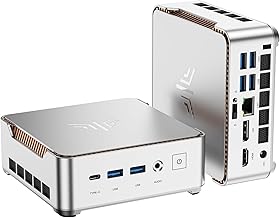
Beelink's new EQi is one of the first mini PCs built on Intel's 18A process node, pairing a Core 3 304 Wildcat Lake processor with connectivity that punches well above typical budget hardware: dual Thunderbolt 4 ports, 10 Gigabit Ethernet, and a secondary 2.5 GbE LAN port. That networking combination makes the compact box particularly appealing as a home server or NAS node, where 10GbE throughput has traditionally required larger, pricier hardware. The whole system fits into a 12.6 x 12.6 x 4.4 cm (5.0 x 5.0 x 1.7 in) chassis with an integrated 85W power supply.
The Core 3 304 is a 5-core chip combining one Cougar Cove performance core clocking up to 4.3 GHz with four Darkmont low-power efficiency cores reaching 3.3 GHz, all within a 15-35W TDP envelope. Beelink claims a 120% single-core improvement over the N305, and the chip includes an Intel NPU 5 delivering up to 24 TOPS of combined AI compute across the NPU and integrated Xe3 GPU. That said, the single Xe-core iGPU with 16 execution units is minimal for anything beyond display output and light media playback.
Linux support for Wildcat Lake is in good shape. Intel engineers have been upstreaming kernel support alongside Panther Lake, and the Linux NPU driver already covers the platform, with version 1.32 adding Wildcat Lake to its device list in April 2026. Early hardware reviews have tested Ubuntu 26.04 on the EQi successfully, so running it as a headless Linux box or self-hosting platform should be straightforward.
The 10GbE port is built around a Realtek RTL8127A, a chip whose r8169 driver support arrived upstream in Linux 6.16. Ubuntu 26.04 ships with kernel 7.0, placing it comfortably past that threshold, so the 10GbE interface requires no additional setup on that distribution. TrueNAS users will want version 26.04 or later, which backported the r8127 driver. Software stacks running kernels older than 6.16 need a DKMS module to bring the interface up.
The base configuration ships with 16GB of soldered LPDDR5 and 512GB of UFS 3.1 flash storage starting at $510 (€470) during pre-order. Neither component is user-replaceable, though two M.2 2280 slots (capped at PCIe 4.0 x2 and x1 respectively) allow adding NVMe storage. Models with socketed DDR5-5600 SO-DIMMs run $660 (€610) for 24GB and $740 (€680) for 32GB, both with 512GB UFS. The remaining I/O includes one USB 3.2 Gen 2 Type-C, one USB 3.2 Gen 2 Type-A, two USB 2.0 ports, HDMI, WiFi 6, and Bluetooth 5.2.