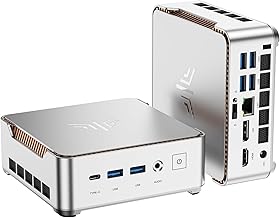
Lenovo has built a mini PC around an Arm chip that is already familiar to the open hardware crowd. The Lenovo AI Host ships with Ubuntu and runs on the Cix CD8180, the same 12-core Armv9 processor that powers two community single-board computers: the Radxa Orion O6 and the Orange Pi 6 Plus. Inside a 100 x 100 x 48mm (3.9 x 3.9 x 1.9 inches) chassis, it skips the Intel, AMD, and Qualcomm silicon that defines most of Lenovo's lineup in favor of a part designed for always-on, low-power AI work.
The CD8180 pairs four Cortex-A720 cores at 2.8 GHz, four more A720 cores at 2.4 GHz, and four efficiency-focused Cortex-A520 cores at 1.8 GHz, alongside Arm Immortalis-G720 MC10 graphics and a 30 TOPS NPU. Lenovo rates the full platform at up to 45 TOPS once the GPU and CPU pitch in. The base configuration carries 8GB of LPDDR5-6000 memory and a 256GB SSD, with connectivity that includes two USB Type-C ports, two USB 3.2 Type-A, two USB 2.0 Type-A, DisplayPort 1.4, HDMI 1.4, and 2.5 GbE.
For anyone tracking Arm-on-the-desktop, the more interesting story is the software state of this silicon. Cix has begun upstreaming the CD8180 and its P1 SoC family to mainline Linux, OpenBSD has added support, and the Orion O6 community already maintains running tallies of what works under mainline Debian. On the local AI front, the platform can run models in the roughly 10-billion-parameter range, with one benchmark clocking around 30 tokens per second on Qwen2-1.5B, which sets realistic expectations for self-hosted inference on a box with 8GB of RAM rather than workstation-class accelerators.
That mainline work has grown more concrete heading into 2026. Foundational P1 SoC support (device tree, pinctrl, mailbox, PCIe) landed in kernel 6.19, though GPU and NPU drivers remain out-of-tree for now, distributed as DKMS packages through the community-maintained cix-gpu-kmd project, which targets kernels 6.12 through 7.0. CIX also published a full technical reference manual and developer guides for the P1's GPU, NPU, and VPU in late 2025, providing the community with the hardware specs needed to push driver support further. For inference workloads, Ollama and llama.cpp currently run on the CD8180's CPU cores only. The NPU is accessible via ONNX through the ZhouyiExecutionProvider, though the libnoe library that underpins the NPU stack remains closed source, a gap the community has formally asked Cix to address.
One caveat for the self-hosting minded: Lenovo bundles its Tianxi AI Claw assistant with more than 20 pre-installed "skills," but the Claw agent itself executes in a cloud-hosted container rather than entirely on-device. The underlying Ubuntu install and the CD8180's open driver work are what make the hardware appealing for running your own stack.
The Lenovo AI Host is up for pre-order in China at 2,999 CNY, or roughly $440 (€405), positioning it well below systems built around NVIDIA's RTX-class Spark or AMD's Strix Halo. Lenovo has not committed to selling it outside China, though the chip's presence in globally available boards leaves the door open.