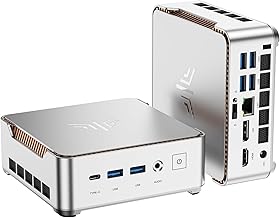
A 1.2 kg (2.6 lbs) box with 128GB of LPDDR5x wired to the SoC at 256GB/s is the headline for anyone chasing large local models without a discrete GPU. AMD has opened pre-orders for its Ryzen AI Halo Developer Platform, a compact mini PC built around the Ryzen AI Max+ 395, starting at $3,999.99 (€3,680) at MicroCenter in both Linux and Windows 11 configurations, US only and limited to in-store pickup.
The Max+ 395 pairs 16 Zen 5 cores and 32 threads clocked up to 5.1 GHz with a Radeon 8060S integrated GPU carrying 40 RDNA 3.5 compute units, plus an XDNA 2 NPU rated at 50 TOPS. Combined, the platform reaches 126 TOPS of INT8 performance inside a 120W TDP, fabbed on TSMC's 4nm process. The system ships with a 2TB M.2 SSD, a 10GbE RJ45 port, WiFi 7 and Bluetooth 5.4, HDMI 2.1b, and three USB-C ports including one with DisplayPort Alt mode, with a fourth USB-C handling power input over USB PD. The chassis measures 150 x 150 x 45.4 mm (5.9 x 5.9 x 1.8 inches).
The draw here is the shared memory architecture. Because the GPU can address the bulk of that 128GB pool, the box can hold models that would otherwise demand multiple datacenter cards, and AMD's own benchmarks lean on exactly that, citing GPT-OSS-120B and Qwen variants. Phoronix reports that Strix Halo hardware support is complete in recent mainline Linux kernels, with one holdout: the chassis RGB LED light bar, which AMD is developing as a separate upstream driver patch. ROCm and Vulkan backends in llama.cpp make local inference workable, though the Radeon 8060S (gfx1151) is not yet listed on AMD's official ROCm support matrix. AMD publishes RDNA 3.5 system optimization guidance specific to Strix Halo, and at this memory scale a required configuration step is adjusting kernel TTM parameters so the iGPU can map the full 128GB pool rather than a limited default. Ollama runs on the Vulkan backend via RADV on this hardware since the bundled ROCm libraries do not include native gfx1151 kernels. The community-maintained strix-halo-guide covers BIOS configuration, kernel setup, and walkthroughs for Ollama, llama.cpp, and vLLM across 70B and 120B GGUF models. AMD points developers to its AI Developer Program and AI Playbooks for inference and fine-tuning guides, though those resources are currently listed as coming soon and should land closer to ship.
AMD positions the platform against NVIDIA's DGX Spark, claiming 4 to 14 percent higher throughput on a selection of models despite the Spark's far larger 1,000 TOPS FP4 figure, and says the box runs 3.3 to 7.3 times faster than an Apple M4 Pro across its tested workloads. Several partners already sell Max+ 395 systems with comparable specs, including the GMKtec EVO-X2 with 128GB and a 2TB SSD at $3,299.99 (€3,050), trading the 10GbE port for 2.5GbE. A higher-end variant is also planned, built on the 133 TOPS Ryzen AI Max+ PRO 495 and paired with 192GB of memory.