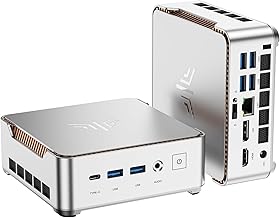
For anyone running large language models at home, the appeal of the new GMK EVO-X3 comes down to a single number: up to 128GB of unified LPDDR5-8000 memory shared between CPU and GPU. The mini workstation is built around AMD's Ryzen AI Max+ 395 "Strix Halo" chip, which combines 16 Zen 5 cores and 32 threads with a Radeon 8060S integrated GPU packing 40 RDNA 3.5 compute units running at up to 2.9 GHz. That memory pool is the headline feature, because a single box that can address well over 100GB of fast memory from the GPU can hold models that would otherwise demand a discrete data-center accelerator.
On Linux, that capability is already practical rather than theoretical. The community has built out a solid stack for Strix Halo: llama.cpp running on the Vulkan/RADV backend, Ollama, and ROCm/HIP paths all work, with detailed setup guides covering BIOS configuration, kernel options, and ROCm installation to run 70B-parameter models on a single APU. AMD's official ROCm support for the gfx1151 target remains in preview, though AMD maintains a dedicated Strix Halo system optimization page in the ROCm documentation and nightly TheRock builds ship native gfx1151 libraries, and projects like CachyOS-based LLM servers have demonstrated production-viable inference on the platform. The pablo-ross/strix-halo-gmktec-evo-x2 repository documents a complete Ubuntu 24.04 setup for llama.cpp with ROCm 7 and rocWMMA on the EVO-X2, which shares the same Strix Halo platform, and lemonade-sdk/llamacpp-rocm provides self-contained llama.cpp binaries that bundle ROCm 7 directly, removing the need for a separate ROCm installation. A bug tracked in AMD's ROCm repository causes the Radeon 8060S to remain stuck at idle clock speeds under ROCm compute load on kernel 6.14, and kernel pinning is broadly recommended to prevent DKMS incompatibilities from automatic upgrades.
The rest of the hardware is built for a workstation role. The EVO-X3 offers two M.2 slots for user-replaceable PCIe 4.0 x4 NVMe storage (configurable with 2TB or 4TB at launch), a MediaTek RZ717 card with WiFi 7 and Bluetooth 5.4, and three fans for active cooling. Connectivity is generous, with HDMI 2.1, full-function USB4 ports handling 40 Gbps transfers, video output, and 100W power input, plus an OCuLink port that exposes a PCIe 4.0 connection for an external GPU dock or other add-ons. The RAM is soldered to the mainboard, but the chassis stays compact, roughly the footprint of a PlayStation 4.
GMK also plans a future variant built on the Ryzen AI Max+ PRO 495, which bumps the GPU to a Radeon 8065S at up to 3 GHz, lifts boost clocks to 5.2 GHz, raises the NPU to 55 TOPS, and most notably supports up to 192GB of LPDDR5-8533. That 50 percent jump in addressable memory is the meaningful difference for local AI work, since it widens the set of models and context lengths a single machine can hold.
GMK has not announced pricing for the EVO-X3. Early access registration opens on 2026-06-22, ahead of a global launch on 2026-06-29.