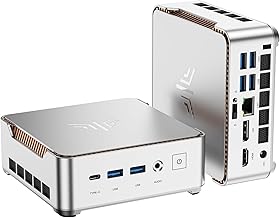
AMD has unveiled the Ryzen AI Max+ PRO 495, a refreshed flagship for its high-end mobile platform that leans hard into on-device AI. The headline change is memory capacity: every chip in the new Ryzen AI Max PRO 400 series now supports up to 192GB of LPDDR5x-8000, with as much as 160GB of that addressable as VRAM. AMD claims that makes the 495 the first x86 client processor capable of running local AI models with more than 300 billion parameters, which is the sort of workload that has so far required a discrete GPU rig or a cloud account.
The silicon underneath is a familiar story. The Max+ PRO 495 keeps the same 16-core, 32-thread Zen 5 layout and Radeon 8065S integrated graphics with 40 RDNA 3.5 cores found in last year's Max+ 395. Clocks tick up modestly, with CPU boost hitting 5.2 GHz (up from 5.1 GHz) and the GPU reaching 3 GHz (up from 2.9 GHz). The integrated NPU now delivers 55 TOPS, up from 50 TOPS. For Linux users and tinkerers eyeing local inference, that combination of a unified memory pool and a beefy iGPU is arguably more interesting than the clock bumps, since llama.cpp and ROCm-aware runtimes can carve out enormous model contexts without leaving system RAM. The open-source ecosystem around this silicon has moved quickly to support it. Lemonade 10.0 landed Linux NPU support for LLMs in March 2026 via FastFlowLM, an NPU-first runtime supporting context lengths up to 256k tokens, while the lemonade-sdk/llamacpp-rocm project ships nightly llama.cpp builds with ROCm 7 acceleration targeting the gfx1151 GPU architecture this chip uses. Full NPU acceleration currently requires Linux 7.0 or the AMDXDNA driver backports being prepared for stable kernels.
The rest of the lineup fills out the stack with the 12-core, 24-thread Ryzen AI Max PRO 490 and the 8-core, 16-thread Ryzen AI Max PRO 485. Both pair down to a 32-core Radeon 8050S iGPU and a 50 TOPS NPU, and on paper they look nearly identical to the outgoing Ryzen AI Max 385 and 390. The 192GB memory ceiling is the practical upgrade, replacing the 128GB cap on the previous generation.
AMD hasn't pinned down a launch date beyond "soon," but it has already confirmed one host system: the company's own Ryzen AI Halo mini PC for developers, which will ship with the Max+ PRO 495 as a configuration option. Pricing for the new chips themselves has not been disclosed.