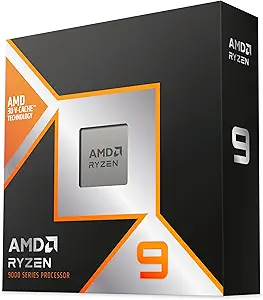
AMD has expanded its Ryzen AI Embedded P100 series with six new system-on-chips announced at Embedded World 2026, doubling the lineup from six to twelve SKUs. The new processors bring up to 12 Zen 5 CPU cores and 80 TOPS of combined AI performance, targeting edge AI applications in industrial automation, robotics, and automotive systems.
The expanded lineup includes the P164, P174, P185, P164i, P174i, and P185i models, available in both commercial and industrial temperature grades (0 to 105°C for commercial, negative 40 to 105°C for industrial). The flagship P185 and P185i processors pack 12 Zen 5 cores running up to 5.1 GHz, 24 MB of L3 cache, RDNA 3.5 graphics with eight work group processors at 2.9 GHz, and a 50 TOPS XDNA 2 NPU. AMD claims the new chips deliver 39% higher multithreaded CPU performance and 2.1 times higher total system TOPS compared to the Ryzen Embedded 8000 series.
The SoCs support unified CPU-GPU memory for low-latency processing in multi-camera machine vision and visual SLAM applications, while the NPU handles power-efficient AI inference tasks like object detection. All commercial models support LPDDR5X memory up to 8533 MT/s and DDR5 at 5600 MT/s with ECC, while industrial variants cap LPDDR5X at 8000 MT/s. The chips include two USB 4.0 ports, multiple USB 3.2 and 2.0 connections, and support for up to four 4K120 or two 8K120 displays. Lower-end P121 and P132 models also feature two 10 gigabit Ethernet ports with Time-Sensitive Networking (TSN) support.
On the software side, the processors now support the AMD ROCm open software stack for running PyTorch and TensorFlow without vendor lock-in, plus a virtualized reference stack based on the Xen hypervisor for consolidating mixed-criticality workloads. The P100 series is certified for ROCm on its RDNA 3.5 integrated GPU and supports Yocto Linux and Ubuntu through the Xen-based virtualization framework. The XDNA 2 NPU gained mainline Linux kernel support in version 6.14 through the amdxdna driver, though full userspace tooling for NPU acceleration on Linux is still maturing. AMD says the chips are optimized for Llama 3.2-Vision, YOLOv12, and MobileSAM. The new 8 to 12 core models are currently sampling to early access customers with production shipments expected in July 2026, while the existing 4 to 6 core variants should reach production in Q2 2026. More details are available in the press release and on the P100 Series product page.