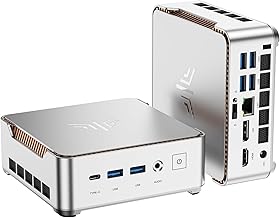
Dual network interfaces on a palm-sized PC tend to catch the attention of anyone running a home firewall or lightweight server, and that is exactly what MSI is offering with its new Cubi NUC TWG series. The compact machines measure just 13.6 x 11.3 x 4 cm (5.3 x 4.4 x 1.6 inches), run on Intel's quad-core Twin Lake processors (N150 or N250) at a 6W TDP, and ship in two variants: the actively cooled TWG and the completely fanless TWG S. Both models feature a 2.5 GbE port alongside a standard Gigabit Ethernet port, plus dual HDMI 2.1 outputs and a USB-C 3.2 Gen 2 port for up to three simultaneous displays.
Internally, the TWG series keeps things straightforward with a single SODIMM slot for DDR5-4800 memory and one M.2 slot supporting PCIe 3.0 x4 storage. Wireless connectivity comes via either an AzureWave card (WiFi 5, Bluetooth 5) or an Intel module (WiFi 6, Bluetooth 5.2). The port selection is generous for something this small: one USB-C and two USB-A ports all running at 10 Gbps, plus four USB 2.0 Type-A ports for peripherals. VESA mount compatibility rounds out the package, letting the system tuck behind a monitor or display panel.
The Cubi NUC TWG is currently listed on MSI's UK site but has not yet appeared on the US storefront, and MSI has not announced pricing. Previous-generation Cubi models with Intel Alder Lake-N processors started at roughly $150 (€138) for barebones configurations, so the TWG series should land in a similar range. For anyone looking for a quiet, low-power box to run a firewall distro, lightweight Docker host, or digital signage setup, the combination of dual NICs, fanless option, and single-digit wattage makes the TWG lineup worth watching. On the Linux side, the N150 and N250 processors rely on the i915 graphics driver, which requires at least kernel 6.11 for the iGPU to initialize, with kernel 6.12 or newer recommended for more reliable results. Community threads on the Proxmox forums and LibreELEC forums reflect active interest in Twin Lake-based systems, with most users reporting clean results once a sufficiently recent kernel is in place.