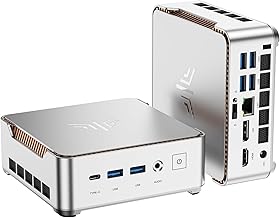
Intel's Wildcat Lake platform is trickling down to budget mini PCs, and the latest to adopt it is the MINIX N304-AI. Built around the Intel Core 3 304, a five-core chip (one P-core, four LP E-cores) clocked up to 4.3 GHz at a 15 W base power, the system integrates a dedicated NPU rated at 15 TOPS alongside Intel Xe3 integrated graphics contributing another 9 TOPS, for a combined 24 TOPS of AI compute. The machine ships with 16 GB of soldered LPDDR5X-6400 memory and a 512 GB PCIe 3.0 x4 NVMe SSD, with two additional M.2 2280 PCIe 4.0 expansion slots (one x2, one x1) supporting up to 4 TB of added storage.
While Windows 11 Pro comes preinstalled, the Wildcat Lake NPU now has solid Linux support. Intel released version 1.38.0-rc1 of its Linux NPU driver on 2026-09-04 with specific Wildcat Lake optimizations, building on the stable 1.35.0 release from July that first added Wildcat Lake firmware. OpenVINO 2026.1 ships with official Wildcat Lake SoC support and now includes a backend for llama.cpp, which opens the door to running local LLM inference directly on the NPU. A Beelink EQi 304 review on LinuxLinks using the same Core 3 304 chip confirmed that the NPU can accelerate small language models under Linux, though the 15 TOPS ceiling keeps expectations modest compared to higher-end Core Ultra parts. CNX Software put numbers to that promise in a separate test of the same chip: running Ubuntu 26.04 LTS on the Linux 7.0 kernel, the NPU drove an INT4-quantized Llama 3.2 1B model through OpenVINO GenAI at roughly 30 tokens per second at short context lengths, dropping to about 22 tokens per second at 8K context. That same review flagged early rough edges on the 7.0 kernel, including the NPU occasionally going undetected and Firefox crashing the GPU driver, both of which cleared up on newer kernel releases.
Connectivity is generous for a box this small. Display output spans HDMI 2.1 TMDS, DisplayPort 1.4, and USB-C 3.2 Gen2, all rated for 4K at 60 Hz with simultaneous triple-monitor support. Dual Gigabit Ethernet ports make the N304-AI a natural fit for routing, firewall, or self-hosting duties, and an M.2 2230 wireless module provides Wi-Fi 6 (802.11ax) and Bluetooth 5.3. The USB complement includes two USB-A 3.2 Gen2 and two USB-A 2.0 ports alongside the USB-C, which MINIX's promotional material says also supports Power Delivery input up to 100 W, though the company's standard specifications list a 65 W maximum via the included 19V/3.42A adapter.
The entire system fits into a 127 x 126.8 x 46 mm (5.0 x 5.0 x 1.8 in) actively cooled enclosure weighing 357.6 g (0.8 lbs), and MINIX includes a VESA mount bracket for display-back installation. The N304-AI is expected to be available at around $399 (€367).