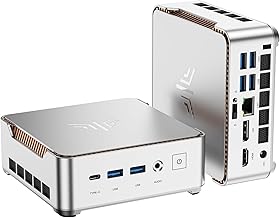
The Framework Desktop is about to become one of the most capable compact platforms for running large language models entirely on-device. A new configuration built around AMD's Gorgon Halo silicon stuffs 192 GB of LPDDR5X unified memory into Framework's modular mini PC, up from the 128 GB ceiling on the existing Strix Halo model. Of that pool, up to 160 GB can be allocated directly to the integrated GPU, enough to fit quantized 70B-parameter models entirely in VRAM. Framework is also introducing a pre-built option with Fedora pre-loaded, alongside the DIY configurations that already officially support Fedora, Windows, and other Linux distributions out of the box.
The upgrade centers on AMD's Ryzen AI Max+ Pro 495, which retains the 16-core, 32-thread Zen 5 layout of its predecessor but bumps the boost clock to 5.2 GHz. Its integrated Radeon 8065S GPU provides 40 RDNA 3.5 compute units, and the XDNA 2 NPU is rated at 55 TOPS, bringing the system's combined AI compute to 131 TOPS. Both are covered by mainline Linux kernel drivers, amdgpu for the GPU and amdxdna for the NPU, and AMD's ROCm 7.14 release added official support for the Gorgon Halo lineup, identifying the Radeon 8065S as a gfx1151 device, the same identifier used by the original Strix Halo chip. That shared identifier means the ROCm and llama.cpp tooling and community guides for tuning kernel GTT and VRAM limits already built around Strix Halo carry over directly to this configuration. Memory bandwidth lands at 273 GB/s across the full 192 GB pool. The 192 GB model ships with a Noctua fan pre-installed, a practical touch for a system that will likely spend long stretches running sustained inference workloads.
Framework made a small but meaningful hardware change on this revision: the PCIe x4 slot is now open-ended, allowing physically larger expansion cards to fit despite the four-lane electrical connection. The company demonstrated a proof of concept using two units fitted with 50 GbE NICs linked over RDMA-over-Ethernet, effectively pooling 384 GB of unified memory across a two-node cluster with tensor parallelism. For anyone building a compact multi-node inference setup, that opens scaling possibilities well beyond what a single box can offer.
Framework has not yet announced pricing for the 192 GB configuration, but the broader Gorgon Halo market offers some reference points. The first third-party Gorgon Halo systems have launched at $7,399 (€6,800), and rising LPDDR5X contract prices throughout 2026 have pushed even 128 GB Strix Halo configurations above $3,450 (€3,170). Pre-orders open on 2026-09-30 in the morning, Pacific Time.