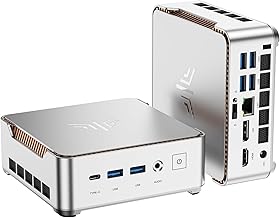
ASRock Industrial has detailed its NUC Ultra 300 BOX Series, a pair of compact industrial mini PCs powered by Intel's Core Ultra Series 3 "Panther Lake" SoC family. First shown at CES 2026 without full specifications, the lineup now comes in four SKUs across two form factors: the standard NUC BOX (117.5 x 110.0 x 49 mm) and the slimmer NUCS BOX (117.5 x 110.0 x 38 mm), each available with either the Intel Core Ultra 5 325 or the Intel Core Ultra 7 358H processor.
The top-tier NUC(S) BOX-358H pairs a 16-core Core Ultra 7 358H (up to 4.8 GHz) with a 12-core Intel Arc B390 GPU, delivering a combined 180 TOPS of AI performance across CPU, GPU, and NPU. The base NUC(S) BOX-325 uses the octa-core Core Ultra 5 325 with 47 TOPS from its NPU alone. Both models support up to 128GB of DDR5 memory (6400 MHz on the Ultra 5, 7200 MHz on the Ultra 7) via two SO-DIMM slots, and offer dual M.2 NVMe slots with PCIe Gen5 x4 and PCIe Gen4 x4 interfaces. Display output covers four independent screens through two HDMI 2.1 ports (up to 7680x4320 at 60 Hz), two DisplayPort 2.1 outputs, and a USB4/Thunderbolt 4 port with DP 2.1. Connectivity includes WiFi 7, Bluetooth 6.0, and at least one 2.5GbE port on all models, with the standard NUC adding a second 2.5GbE jack.
The NUC Ultra 300 BOX shares its physical design with the Arrow Lake-based NUC Ultra 200 BOX series from early 2025, and ships with a 19V 120W power adapter and a VESA mount bracket. The units accept 12V to 24V DC input and support both AT and ATX power modes, making them suited for industrial deployments. Although ASRock's product pages and datasheets list only Windows 10 and Windows 11 as supported operating systems, the Linux outlook for the Series 3 hardware is encouraging: Phoronix has reported that the Arc B390 Xe3 graphics perform well under the open-source Intel compute runtime, and LinuxLinks has documented the identically sized Arrow Lake predecessor running Ubuntu without significant issues, suggesting a reasonable baseline for self-hosters willing to run an upstream kernel. Linux 7.0 has also added Panther Lake workload hints for improved power management, and the open-source Mesa stack already carries Xe3 graphics support across major distributions including Ubuntu, Fedora, and Arch Linux. Pricing is not publicly listed, and interested buyers will need to request a quote through distributors.