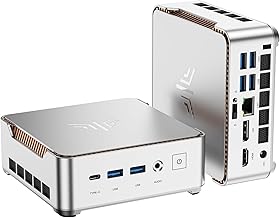
Intel's budget-tier Wildcat Lake-U processors now have their first NUC homes. ASRock Industrial has launched four compact platforms built on the Core 5 320 and Core 3 304 chips, split between two ready-to-run mini PCs (the NUC BOX-320 and NUC BOX-304) and two bare motherboards (the NUC-320 and NUC-304) meant for custom embedded builds. All four share a common feature set: up to 64GB of single-channel DDR5-6400 with In-Band ECC via one SO-DIMM slot, dual M.2 Key M storage (PCIe Gen4), dual 2.5GbE networking from Intel I226V and Realtek RTL8125BG controllers, and support for up to three independent 4K displays through two HDMI 2.1 outputs and DisplayPort over USB-C.
The Core 5 320 packs six cores (two performance, four low-power efficiency) while the Core 3 304 drops to five (one performance, four LP-E), and both integrate Intel's NPU for up to 40 TOPS of AI inference. The BOX models are fan-cooled mini PCs measuring 11.75 x 11.0 x 4.9 cm (4.6 x 4.3 x 1.9 inches), with two USB 3.2 Gen2x2 Type-C ports, three USB-A ports, an M.2 Key E 2230 slot for Wi-Fi 6E and Bluetooth 5.3, and a 19V/90W DC adapter. The motherboard variants shrink to a 10.4 x 10.2 cm (4.1 x 4.0 inches) footprint and trade the enclosure for a wider operating temperature range of -20°C to 70°C (-4°F to 158°F), plus a configurable RS-232/422/485 COM port and two internal USB 2.0 headers for industrial integration.
ASRock Industrial officially lists only Windows 10 and 11 compatibility, but Linux support for Wildcat Lake-U is already well established upstream. Core enablement patches landed in Linux 6.16, released in July 2025, covering audio, HID, and thermal drivers. Subsequent kernel releases added SPI flash and LPSS support in 6.18, and Intel's standalone NPU driver has supported the platform since v1.32.0. The Intel I226V NIC has been well supported in mainline kernels for years, and the Realtek RTL8125BG works with the widely available r8169 driver, so running a current Linux distribution on these boxes should be straightforward.
The dual 2.5GbE NICs, ECC memory support, and compact form factor make both the BOX and board variants interesting candidates for lightweight firewalls, Proxmox nodes, or home automation gateways. The bare motherboards, with their serial port and extended temperature tolerance, lean further toward industrial and edge deployments. Pricing has not been disclosed.