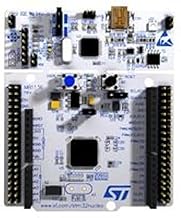
Building compact embedded UIs on a budget just got a little easier. Maker Go has released a development board built around ST's STM32U575VGT6 microcontroller that comes with a built-in FPC connector for directly attaching small LCD panels, 8MB of external SPI flash, and a microSD card slot. At $15 (€14) for the bare board, it targets makers who want to prototype display-driven projects without wiring up breakout boards or dealing with adapter cables.
The STM32U575VGT6 at its core runs an Arm Cortex-M33 clocked at 160 MHz with 786 KB of SRAM and 1 MB of internal flash. It supports Arm TrustZone and includes ST's Chrom-ART (DMA2D) accelerator for hardware-assisted 2D graphics rendering, which pairs well with the board's display connector. That FPC interface accepts either 1.47-inch (320x172) or 2.0-inch (320x240) LCD panels via ribbon cable. Two rows of 48-pin headers break out the MCU's generous GPIO count along with 3.3V and 5V power rails, and the whole board measures just 59.7 x 35.8 mm (2.4 x 1.4 inches) in a breadboard-friendly form factor. Headers are included but require soldering.
Flashing firmware works over USB Type-C, a standard SWD interface (compatible with ST-Link debuggers), or serial. On the software side, STMicroelectronics provides the STM32Cube IDE and HAL libraries for C/C++ development. There is no dedicated MicroPython build for this specific board, but MicroPython v1.27 introduced core support for the STM32U5 family, so getting an interpreter running on the U575 should be feasible with some configuration work. Linux developers leaning on open-source tooling will find that the stlink programming toolset added STM32U5 series support for command-line SWD flashing, and Zephyr RTOS already carries STM32U575 MCU support in its mainline tree and ships with LVGL as an integrated graphics module, offering a fully open-source path to the display-driven applications this board is clearly designed for. For anyone looking at ultra-low-power embedded projects that still need a graphical interface, this compact board packs a lot of connectivity into a small footprint.