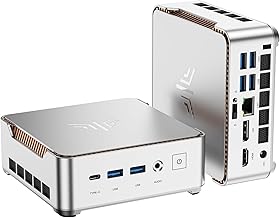
ASRock is updating its iBOX industrial mini PC family with Intel's new Panther Lake silicon, putting Core Ultra Series 300 processors inside a passively cooled aluminum chassis. The case carries over from the Series 200 generation released earlier in 2026, with heat-dissipation fins running along the top and sides, dimensions of 20 x 17.6 x 5.36 cm (7.87 x 6.95 x 2.11 inches), and a weight of 3 kg (6.6 lbs).
Buyers pick between the Core Ultra X7 358H, with 4 performance, 8 efficient, and 4 low-power efficient cores, or the more modest Core Ultra 5 325, which drops to 4P and 4 LPE cores. Memory tops out at 128 GB of DDR5-7200 on the X7 build and DDR5-6400 on the Ultra 5. Storage is split across an M.2 2242 PCIe 4.0 x4 slot and an M.2 2280 PCIe 5.0 slot, giving the box room for a fast boot drive plus a higher-capacity secondary SSD.
The port layout is the more interesting part for anyone deploying these as small Linux workstations or edge servers. The front carries a Thunderbolt 4 jack with DisplayPort 2.1 output, one 10 Gbps USB-A port, a 20 Gbps USB-C port with DP 1.4a alt mode, two USB 2.0 ports, and a Realtek ALC256 combo audio jack. A configurable cutout can be ordered as a legacy serial or VGA connector. Around the back sit two more 10 Gbps USB-A ports, two HDMI 2.1 outputs, and dual 2.5 Gbps Ethernet jacks, which make the unit a natural fit for OPNsense, pfSense, or homelab routing duty. Wi-Fi is not included by default, but there is an M.2 2230 PCIe x1 slot for users who want to add a card. Linux users evaluating the platform should be aware that Panther Lake SoC support is still maturing in the upstream kernel: Basecamp's Omarchy currently ships a patched Linux 6.19 kernel with roughly 20 Panther Lake backports to bridge the gap, with full upstream inclusion expected when Linux 7.0 ships.
ASRock is not publishing pricing or a launch date publicly, and configurations are quoted through direct inquiry with the company, which is typical for the iBOX industrial line.